


 Graduate Program in Global Studies
 Area Studies
 International Relations
 International Cooperation
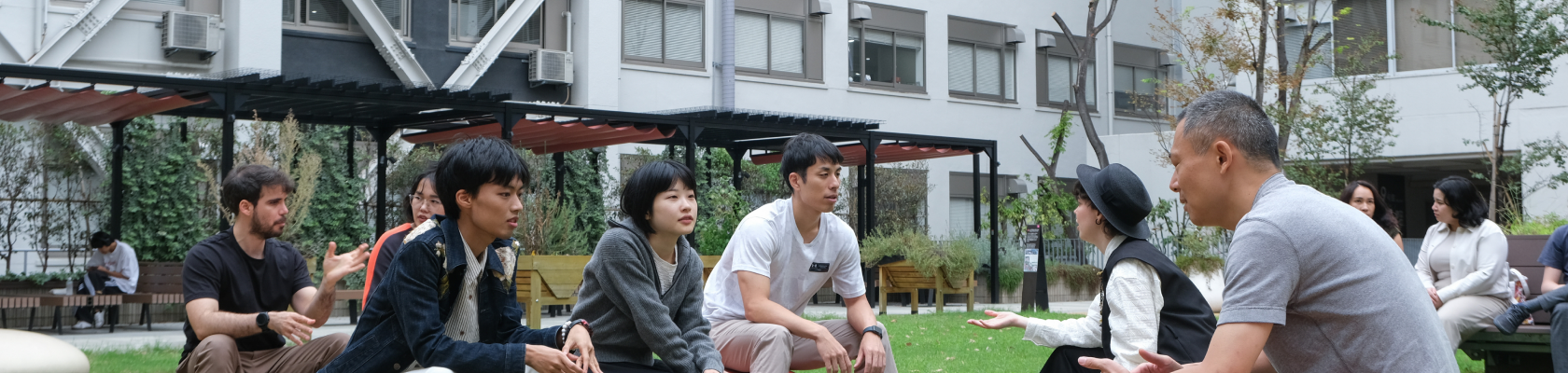
The Graduate School of Global Studies, located in central Tokyo, is among the largest university institutes in the world for the advanced study of globalization.
The Graduate School of Global Studies is devoted to producing innovative knowledge about globalization. It encourages inquiry into such relevant issues as nationalism, development, international conflicts, religion, civil society, race and ethnicity, gender, world literature and arts, immigration and refugees, international marketing and business, digitalization, global consumption, and environment. This inquiry is conducted irrespective of disciplinary boundaries of the humanities and social science disciplines. It includes theoretical, empirical, policy-relevant, and socially engaged studies. The aim is to train persons who can face the challenges that they pose and work creatively and flexibly towards solutions.
The Graduate School of Global Studies embodies the cosmopolitan and humanistic principles of Sophia University, founded in 1913 by the Jesuit Order of the Catholic Church. These include respect for human dignity, equal rights and social justice, cultural diversity, and responsibility for the shared destiny of all human beings.
From its founding, Sophia University has been a leader of the internationalization of higher education in Japan. It pioneered the study of foreign languages, international and area studies, conduct of courses in both English and Japanese, and welcoming of international exchange students. Today, it is a top-ranked, medium-sized research university with a culturally diverse faculty and student body. It is one of the few institutions to receive funding from the Japan Ministry of Education for the “Top Global University Project” to deepen the internationalization of higher education.
The idea to found the Graduate School of Global Studies began in 1999 with discussions among faculty members in area studies and international relations. They were attracted to the emerging field of global studies that transcended the methodological nationalism in the humanities and social sciences to enable holistic perspectives on the complexity of phenomena in the world. In 2002, they took the first step to set up the new graduate school by receiving a competitive grant from the Japan Ministry of Education for a project titled “Towards an Area-Based Global Studies (AGLOS)”
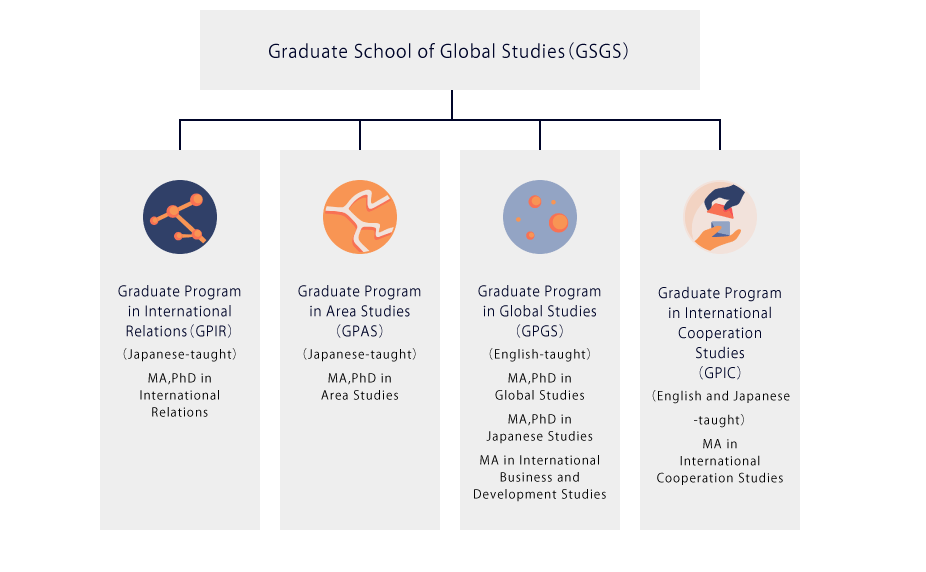
Opened in 2006, the Graduate School of Global Studies brings together three pre-existing programs: the Graduate Program in International Relations, Graduate Program in Area Studies, and Graduate Program in Global Studies (formerly Comparative Culture). Their combined international reputations and more than seventy years of institutional experience have been a solid foundation for the school’s development. In 2021, the school will open a fourth program, the Graduate Program in International Cooperation Studies.
The Graduate School of Global Studies has about seventy faculty members, and almost two hundred students encompassing three dozen nationalities. It is composed of four programs, two of them English-taught. Each program has its own focus, as well as admissions, curriculums, and degrees.
The Graduate Program in International Relations offers multi-faceted and comprehensive education on aspects of international relations and functions of the international system. The Graduate Program in Area Studies focuses on the various aspects of societies and histories in Asia, the Middle East, Africa, Latin America, and Europe. The Graduate Program in Global Studies (English-taught) encourages comparative, glocal, and transnational studies that emphasize Japan and East Asia, and their links to other parts of the world. The Graduate Program in International Cooperation Studies (English and Japanese-taught), from 2021, will train mid-career professionals for work in international economic and social development.
The Graduate School in Global Studies draws on resources Sophia University. It cross-lists courses from the Graduate School on Environmental Studies, the Department of Education, and other relevant areas. Research and teaching are supported by specialized institutes: Institute of Asian, African, and Middle Eastern Studies; Iberoamerican Institute; Institute of Comparative Culture; Institute of Global Concern; Asia Center for Research and Human Development, Center for Islamic Studies, Institute of International Relations; Institute of American and Canadian Studies; and the European Institute.
Personnel
Dean: Sven Saaler
Professor of Modern Japanese History, Graduate Program in Global Studies
Administrative Assistant: Ayako Hirokata
For deans in previous years,
click here.
PD: Edward Lugo Asis
PhD in Global Studies, Sophia University
Research Interest: Migrants, Mental Health, Aging/Gerontology, Human Rights, and Global Health
PD:Sta. Romana Michelle
Doctoral Candidate in Global Studies Research Interest:Populism, Democratization and Authoritarianism, Political Narratives in Philippines and Southeast Asia
RA:Conde Amorim Samuel
Doctoral Student in Area Studies
Research Interest:International Relations
RA:Rallonza Miguel Niccolo Veneracion
Doctoral Student in Global Studies
Research Interest:Anthropology, Food and Culture, Global Studies, Area Studies (Philippines)
RA:Nettmann Klaus Wilhelm
Doctoral Student in Global Studies
Research Interest:Japanese Pan-Asianism
For personnel in previous years,
click here.